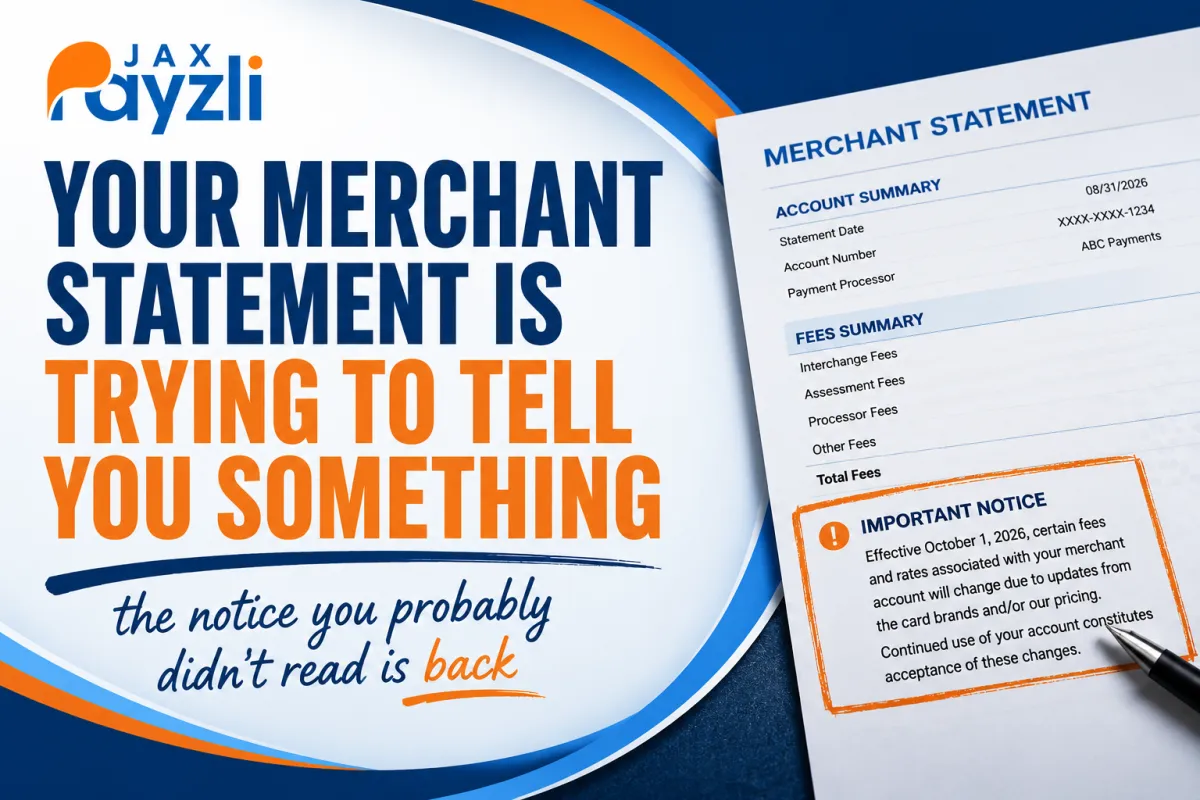
Your Merchant Statement Is Trying to Tell You Something
The Notice You Probably Didn't Read Is Back.
If you own a business that accepts credit cards, there’s something you should do before you get too far into September:
Pull out your most recent merchant statement.
Not the first page.
Not the page showing your total processing fees.
Go to the Notes, Notices, or Important Information section.
Because somewhere in that statement, there may be a small paragraph warning you about changes coming to your processing costs in October.
And if you missed it?
You’re not alone.
Most business owners never see it.
That’s exactly why it matters.
If This Sounds Familiar, It Should!
Back in March, we published “The Harsh Reality of Rate Increases” to warn merchants about the upcoming Spring Release.
The message was simple:
Don't automatically accept a rate increase just because your processor says the card brands changed their rates.
The Spring Release took effect in April.
Now we're approaching the other half of the cycle:
The Fall Release is coming in October.
And if history is any indication, some merchants will soon receive a familiar message:
“Due to changes from the card brands, your rates and/or fees will be adjusted.”
Before that happens, there's something you should know:
The notice may already be sitting in your most recent merchant statement.
The Fall Release Is Coming
Twice a year, the payment industry goes through a cycle of card brand updates:
Spring Release — > April
Fall Release — > October
Visa and Mastercard periodically update interchange rates, qualification criteria, and other elements of their payment networks.
And when those changes happen, your processor may make changes to your pricing as well.
But here’s the part merchants need to understand:
A card brand update does not automatically mean your entire processing bill should go up.
Some costs may increase.
Some may decrease.
Some may not change at all.
And even when the underlying cost of a particular transaction changes, that doesn't automatically explain an increase to every fee on your statement.
That distinction is important.
The Notice May Already Be in Your Hands
Here’s where September becomes important.
If your processor is making a pricing change effective in October, the notification may already be sitting inside your most recent statement.
For many merchants, that means the August statement, which is typically delivered or made available in early September.
The notice may be buried under a heading such as:
Important Notice
Fee Changes
Merchant Processing Updates
Interchange Updates
Pricing Changes
Or simply:
Notes
And it probably won't be written in giant letters.
It may be a paragraph of dense industry language that most business owners understandably skip.
But buried inside that paragraph could be the information that tells you:
Your processing costs are about to change.
Here's the Timeline to Watch
Think of it this way:
August Statement
Your processor may include the advance notice.
Early September
Your August statement becomes available. This is when you should look for it.
October
The Fall Release and/or processor pricing changes take effect.
November
You may finally notice the financial impact when reviewing your October processing activity.
And by then? The change has already happened.
The Sentence Merchants Need to Pay Attention To
The wording varies from processor to processor, but the message often sounds something like:
"Effective October 1, certain fees associated with your merchant account will change..."
Or:
"Due to changes in card brand costs, your pricing will be adjusted..."
And somewhere in the fine print may be language explaining that continued use of the account constitutes acceptance of the new terms.
That last part is particularly important.
Because if you don't know a change is coming, you can't evaluate it.
And if you don't evaluate it, you may simply accept it as another unavoidable cost of doing business.
But Is It Really the Card Brands?
This is where things get interesting.
When a processor tells you:
"Card brands are increasing their rates."
there are actually several different questions you should ask.
Which card brand?
Visa?
Mastercard?
Both?
Which rates?
Interchange?
Network fees?
Something else?
Which transactions are affected?
All transactions?
Specific card types?
Specific industries?
Specific transaction methods?
And most importantly...
How does that change affect YOUR business?
Because your business doesn't process an "average" transaction.
You process your transactions.
Your customers.
Your card mix.
Your average ticket.
Your transaction methods.
Your industry.
Your processing volume.
ALL of that matters.
A Rate Change Doesn't Give Anyone a Blank Check
This is the part I wish more business owners understood.
When the card networks make changes, those changes can create legitimate cost increases for processors.
That's real.
But there is a difference between:
Passing along a legitimate increase in cost
and
Using a legitimate industry event as an opportunity to increase pricing beyond the actual impact.
Those are two very different things.
For example, if a particular card category becomes more expensive but represents a small percentage of your transactions, the actual impact on your business may be minimal.
Yet a processor could potentially make a broader pricing adjustment to all of the cards you accept.
That's why simply hearing:
"The card brands increased their rates."
isn't enough.
You need to know what changed and what it means for you.
Don't Just Look at Your Percentage
Another trap is focusing exclusively on your advertised processing rate.
Let's say your processor tells you:
"Your rate is only increasing by 0.10%."
That might sound insignificant.
But your actual processing costs aren't determined by one number.
There can be:
Interchange costs
Assessment or network fees
Processor markup
Per-transaction fees
Monthly fees
Authorization fees
Gateway fees
Statement fees
Batch fees
Other account-level charges
A small change in several places can become a meaningful increase over the course of a year.
That's why looking only at the "rate" can miss the bigger picture.
What Should a Good Processor Do?
A good payment processor shouldn't simply send you a notice and expect you to figure it out.
They should be able to explain:
What changed?
Why did it change?
Which transactions are affected?
How much will it actually cost you?
Is the change coming from the card brands, the processor, or both?
And perhaps the most important question:
Is the change actually necessary for your specific account?
Because your business deserves more than a generic explanation and blanket increase across the board.
Your September Homework
This month, take five minutes.
Pull up your most recent merchant statement.
Go to the Notes, Notices, or Important Information section.
Look for anything mentioning:
October
Fall Release
Interchange
Card brand changes
Pricing changes
Fee changes
New fees
Increased fees
Processing rate adjustments
If you find something, don't automatically panic.
And don't automatically accept it either.
Read it.
Then ask your processor to explain exactly what it means for your business.
If they can't clearly explain it?
That's worth paying attention to, too.
The Bottom Line
The Fall Release isn't a secret.
The card networks publish their updates semi-annually as here stated by Mastercard.
Processors know changes are coming and merchants are generally given advance notice of pricing changes under their agreements and applicable requirements.
The problem is that the notice is often buried in the one place most business owners rarely read: the fine print of their merchant statement.
So before October arrives and you suddenly notice that your processing costs have increased, look now.
Your August statement may already contain the warning.
And remember:
A notice that says your costs are going up is not the same thing as an explanation of why they're going up.
You have every right to ask:
"Show me exactly where the increase is coming from and where it applies to me"
Want an Expert to Take a Second Look?
At Jax Payzli, we believe business owners shouldn't need a degree in payment processing to understand what they're paying.
That's why we created MerchantCheckUp™.
We'll review your merchant statement and help identify:
What you're actually paying
Where your fees are coming from
Whether recent changes are related to card brands or processor pricing
Where additional fees may be hiding
Potential opportunities to reduce unnecessary costs
No commitment. No pressure. Just answers.
If nothing is wrong, you'll know.
If something changed, you'll know what changed and why.
Request your complimentary MerchantCheckUp™.
Because the best time to question an increase is before you start paying for it.