The Most Misleading Number in Merchant Services: The Quote
Why Advertised Rates Don’t Tell the Whole Story
The Quote Trap
When shopping for merchant services, most business owners focus on one thing:
The Proposed Merchant Discount Rate (MDR). The lower the number, the better the deal... right?
Not necessarily.
Because in payment processing, the advertised rate is often only a small piece of the overall cost.
Even Mastercard acknowledges that interchange rates alone do not represent the total cost of acceptance. In fact, Mastercard states that interchange rates are “only one of many cost components included in a Merchant Discount Rate (MDR).” In other words, the percentage merchants are shown during the sales process is often just one piece of the overall expense structure.
What matters is not what you were quoted.
What matters is what you actually pay after every transaction fee, downgrade, assessment, pass-through charge, monthly fee, and network cost hits your statement.
That number is called your effective rate.
And for many businesses, it looks dramatically different than the quote that got them to sign up in the first place.
The Fees You Agreed to Without Realizing It
During the sales process, most proposals heavily focus on the “processing rate” being offered by the merchant service provider.
That’s the headline number.
That’s the number highlighted in large font.
That’s the number used to win the deal.
What often receives far less attention are all the other costs involved in getting a transaction from Point A to Point B.
Network access fees
Assessments
Pass-through charges
Gateway fees
Card brand fees
And when these charges finally appear on a statement, the explanation is usually something like:
“That’s not our fee - that comes from Visa.”
While technically true in several instances, those costs still impact your bottom line, and they should have been explained to you with your proposal.
Whether the fee originates from the processor, the gateway, or the card brands themselves makes very little difference to the business owner paying the bill.
The reality is simple:
If it appears on your statement, it contributes to your effective rate.
The Starting Rate vs. the Final Rate
One of the most common surprises in merchant services happens after the account is already open.
A business owner signs up based on an attractive advertised rate, which is often referred to as a “qualified rate”.
Then the first statement arrives. Usually sometime between the 3rd - 8th of the following month. And suddenly, the majority of transactions didn’t “qualify” for that original low rate after all.
How Convenient.
That’s because each merchant service provider creates what’s called a qualification grid that determines which transactions receive the lowest rate and which are bumped into more expensive categories like “mid-qualified” or “non-qualified”.
The problem? Merchants never see what those qualification requirements actually are.
And here’s the reality many providers fail to mention:
The overwhelming majority of credit cards in circulation today include some type of rewards program, points system, airline miles, cashback incentive, or business purchasing feature.
Those card types will almost NEVER qualify for the lowest advertised rate.
In other words, the quote that got your attention may only apply to a small percentage of the cards you actually accept.
The rest are processed at higher rates (in other words they downgrade into a more expensive category with additional costs) that often aren’t discovered until the first statement arrives - when it’s already too late.
This is one reason many businesses are now exploring transparent Flat Rate Programs instead of traditional tiered or interchange plus pricing models. Be careful however as many advertised flat rate programs are not flat at all since they have transaction fees or different rates for swiped card vs. keyed in card numbers (which ultimately changes the overall cost at the end of the day).
Every Fee Can Be Turned Into a Rate
This is one of the most important concepts in payment processing:
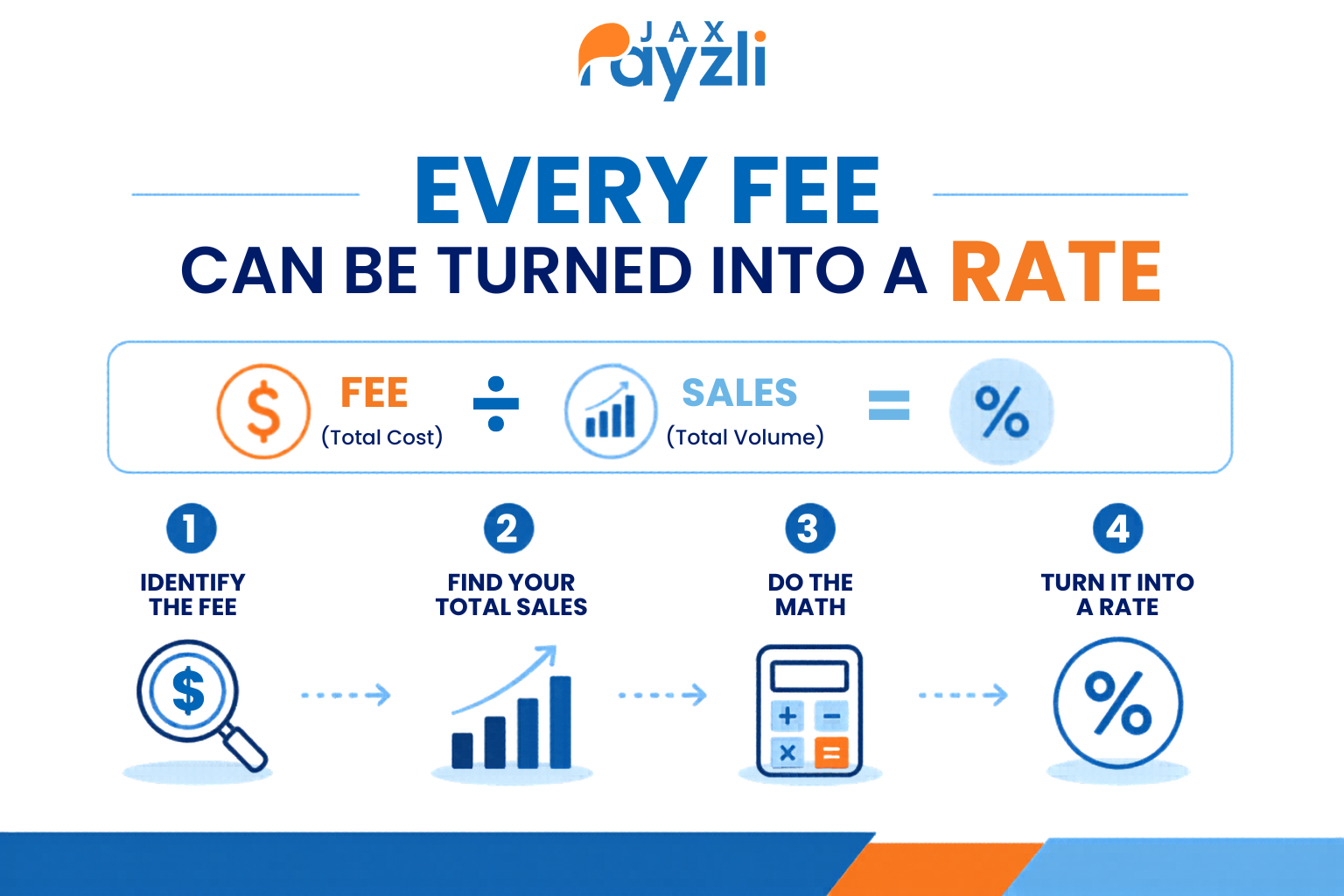
Every fee can be converted into a rate. That goes for:
Transaction fees
PCI Compliance fees
Settlement /Batch fees
Statement fees
Network fees
Annual fees
Dues & Assessments
Pass-throughs
All of them.
And once you convert every fee into a percentage of sales, you stop evaluating random line items and start understanding your true cost.
That true cost is called your effective rate.
Your effective rate is the percentage of total sales that actually leaves your bank account after ALL processing costs are included.
Which means it doesn’t matter if you were quoted 1.79%.
If your total fees at the end of the month equal 3.12% of your sales volume... Then you’re paying 3.12%. Not 1.79%.
That’s why smart merchants don’t focus solely on the original quoted rate. They focus on the effective rate which can and should be calculated each month when you get your statement by taking the total fees and simply dividing them by your total sales.
The Quarter That Doesn’t Look Like Much
Transaction fees have a much larger impact on businesses with lower average tickets than many merchants realize. And, this is where “small” fees become surprisingly expensive.
Let’s use a coffee shop as an example.
A merchant is quoted:
2.59% + 25¢ per transaction
At first glance, the 25 cent transaction fee doesn’t seem significant. Might not even pick that up off the ground if you were walking by. But now let’s apply it to a five dollar cup of coffee.
The percentage rate equals:
$5.00 × 2.59% = $0.13
Now add the 25¢ transaction fee:
$0.13 + $0.25 = $0.38 total processing cost
Now divide the total fees by the sale amount:
$0.38 ÷ $5.00 = 7.60%
That “2.59%” quote suddenly became a 7.60% effective rate on that transaction.
The quote didn’t change.
The simple math, that merchants rarely take the time to do, just exposed the reality.
And this is exactly why average ticket size matters so much when evaluating payment processing.
Dues, Assessments, and Pass-Throughs Add Up
Many merchants underestimate how quickly these “small” charges accumulate.
Card brands charge various dues and assessments to support and maintain the payment networks.
Processors and gateways may add additional pass-through fees tied to authorizations, data transmission, compliance programs, or network access.
Individually, many of these fees appear minor. Combined, they materially increase your total cost of acceptance.
For many businesses, dues, assessments, and pass-through charges alone can add approximately 0.25% or more to the effective rate before processor markup is even considered.
That means a merchant quoted at 2.25% may already be closer to 2.50% before accounting for transaction fees, monthly fees, or all other charges.
And most merchants never realize it because these costs don’t typically have a number next to them on the Merchant Processing Application (MPA) but rather small, easily overlooked check boxes with no apparent value assigned to them.
But please believe each one has a cost if checked off!
Here is an example:

The Only Number That Matters
Quotes are marketing.
Statements are reality.
At the end of the day, there is only one number that truly matters:
Your Effective Rate.
Because this is the number that tells you what percentage of your revenue actually left your business to accept credit cards.
Not the advertised rate.
Not the teaser rate.
Not the “qualified” rate.
The Effective Rate.
Final Thoughts
If you’re evaluating your current merchant services, don’t stop at the quote.
You need to know what you’re actually going to be paying at the end of the day.
At Jax Payzli we provide a complimentary MerchantCheckUp™ where we break down every fee inside your existing merchant statements and calculate your true effective rate for you so you can see exactly where your money is going.
And if you include your original processing quote along with a current merchant statement, we can often show you side-by-side exactly where the differences occurred - including downgrades, pass-through charges, assessments, and other costs that may not have been obvious during the sales process.