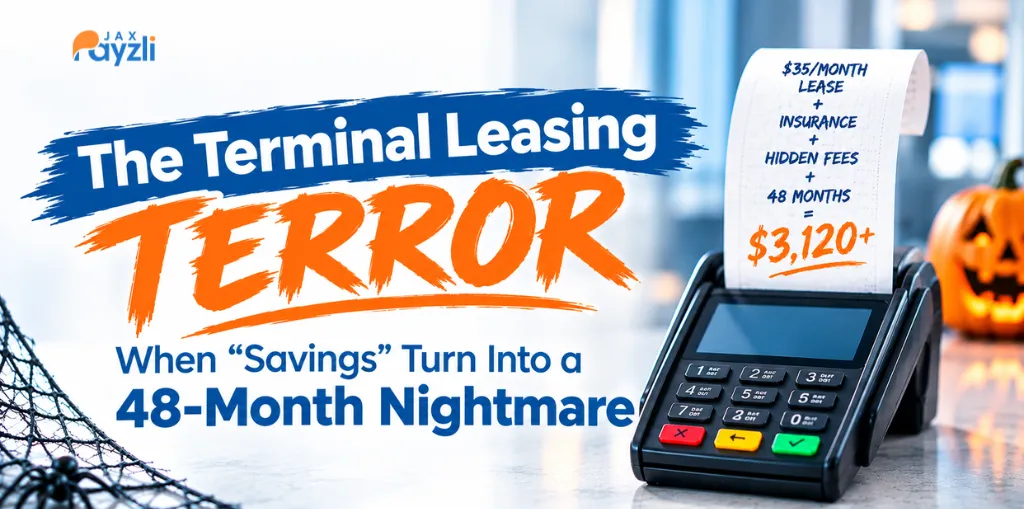
The Terminal Leasing Terror: When “Savings” Turn Into a 48-Month Nightmare
It all started with a promise to save $85 a month. It ended with a 48-month obligation nobody saw coming.
A business owner was told their credit card processing costs could be reduced by about $85 per month. Additionally, they were told that their existing credit card terminal could supposedly be reprogrammed, so there was no reason to buy new equipment.
Sounds good, right? $85 per month equals $1,020 savings per year with no out of pocket expenses to get started.
The merchant completed a new application, expecting lower processing costs and a relatively painless transition.
Then came the approval.
There was just one problem:
Their existing terminal wasn't compatible after all.
But don't worry. There was a solution. They could lease a new terminal for just $35 per month.
And the sales pitch made the math sound pretty simple:
“You're saving about $85 a month, so the $35 terminal lease is basically being paid for by your savings. You'll still be about $50 ahead every month.”
Problem solved. Or so it seemed.
Then the first monster appeared: The Lease.
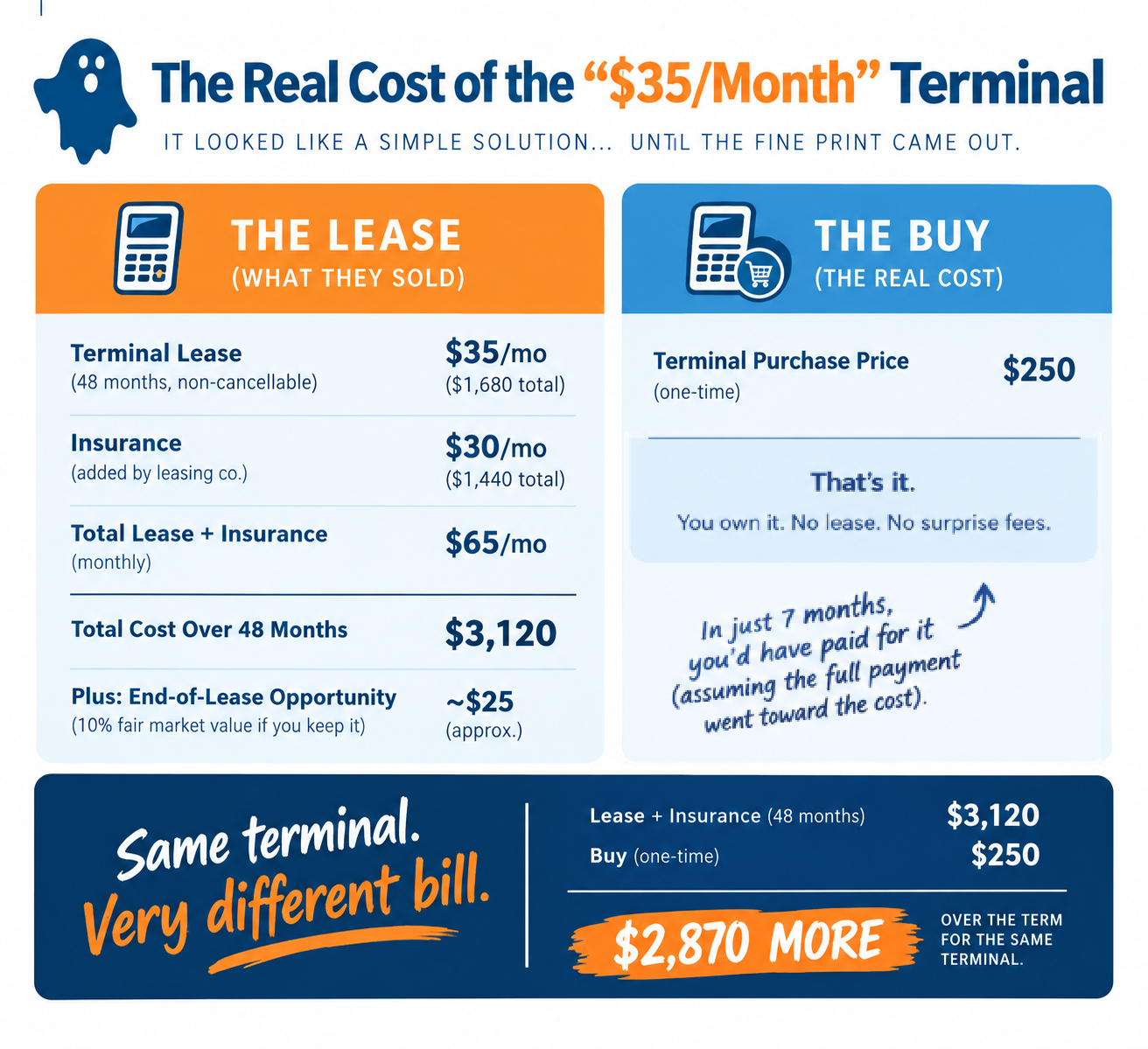
The terminal being leased was not an expensive piece of specialized equipment. It was a standard credit card terminal that could be purchased outright for approximately $250.
At $85 per month in savings, the merchant could have re-cooped the cost of the terminal in roughly 3 months:
$250 ÷ $85 = 2.94 months
At $35 lease payments per month, the merchant would have technically paid for the cost of the terminal in roughly 7 months:
$250 ÷ $35 = 7.1 months
Unfortunately, the cost to simply buy the machine was never disclosed to them.
They were signing a 48-month, non-cancellable lease.
That's a total of $1,680 in lease payments:
$35 × 48 months = $1,680
For a terminal that costs roughly $250 to purchase.
And here's the part that makes this particularly unsettling:
The merchant doesn't own the terminal at the end of the lease simply because they've made all those payments.
But Halloween month is just getting started...
About 30 days later, a notice arrives directly from the leasing company. The merchant learns that the leased equipment was required to be insured and they missed the deadline.
Just like leasing a car, the leasing company wants proof that its equipment is covered. Except nobody had really explained that part when the terminal was presented as a simple $35-per-month solution.
Because the merchant failed to provide proof that the machine was added to their business insurance, the leasing company added insurance through its own preferred provider and will be automatically withdrawing the premium directly from the merchant's bank account (which they were given access to by the merchant service provider).
And that insurance isn't necessarily going to be the least expensive option.
In this case, the additional cost was approximately $30 per month.
So the $35 terminal lease has now become:
$35 lease + $30 insurance = $65 per month
If the original savings were really $85 per month, the merchant is now theoretically only $20 ahead.
But remember...
We haven't gotten to the processing statement yet.
Enter: The Statement from the Underworld
The first monthly merchant statement arrives.
And instead of being simpler and less expensive, it's somehow more confusing than the previous processor's statement.
There are interchange categories.
Assessment fees.
Network fees.
Miscellaneous fees.
Other fees they never had before.
The merchant looks back at the application they completed…
Sure enough, there are all sorts of boxes checked that align with these additional fees. But many of those boxes simply contain the name of an interchange category or pricing term, rather than a clear dollar amount showing what that fee will actually cost the business.
The merchant was focused on the promised savings that they were “sold” on.
But the statement tells a very different story.
The supposed $85 monthly savings? Not even close to what it looked like during the sales pitch.
Just when they think the nightmare is over...
The merchant is now stuck in contract with the merchant service provider and that 4 year lease doesn't necessarily end just because the merchant has been paying for 48 months.
They have to remember to end it themselves. Four years later!
There is a process for terminating it. And if the merchant doesn't take the appropriate action, payments will continue until they realize it.
At that stage, the terminal could be:
Broken.
Outdated.
Sitting in a drawer.
Replaced by newer technology.
Completely obsolete.
And the lease payment can still keep coming out of the business bank account.
That's a particularly nasty little piece of fine print.
Because a business owner shouldn't have to remember that a four-year-old piece of equipment, they may no longer even use, is still generating an automatic withdrawal.
And what happens when the lease finally ends?
Let's say the merchant makes it all the way through the 48 months.
They have now paid:
$1,680 in lease payments
on equipment that originally cost approximately:
$250
And if they want to keep the terminal, they may still be required to pay 10% of its fair market value at the end of the lease, depending on the lease agreement.
So, after paying nearly seven times the original purchase price, and fulfilling the 48 payments, the merchant may still have another step and another payment to actually keep the equipment.
If they choose not to keep the equipment they must return it (so hopefully they kept it).
And there's one more uncomfortable reality:
Technology doesn't wait four years.
Credit card processing technology changes quickly.
Terminals evolve.
Security standards change.
Payment methods change.
EMV, contactless payments, mobile wallets, software integrations, operating systems and security requirements all continue to evolve. And quicker than ever as of late.
A terminal that works perfectly today may not be the terminal you want, or even be able, to use four years from now.
So, the business owner could potentially spend $1,680 or more over four years leasing a piece of equipment that may become outdated before the lease is over.
The real horror story isn't the terminal.
Here's the thing:
There is nothing inherently wrong with buying equipment.
There is nothing inherently wrong with financing equipment.
And there may even be situations where leasing equipment makes sense for a particular business.
The problem is when the merchant doesn't understand what they're actually agreeing to.
A $35 payment sounds very different from a $1,680 commitment.
A $35 payment plus $30 in insurance sounds very different from $35 (almost double).
A “savings of $85 per month” sounds very different when the actual processing statement doesn't produce those savings.
And a four-year lease sounds very different when the merchant isn't told that they are responsible for remembering to terminate it.
That's why the cheapest-looking number isn't always the number that matters.
Before you sign the lease, ask these questions:
1. How much does the equipment cost if I buy it outright?
Don't compare a monthly lease payment to nothing. Make sure to compare the total lease cost to the actual purchase price.
2. How long is the lease?
Three years? Four years? Longer?
Know the full term before signing.
3. Is the lease cancellable?
If your business closes, changes processors, replaces the equipment or simply doesn't need it anymore, what happens?
4. Do I own the equipment at the end?
Don't assume that making every payment means you own it.
5. Is insurance required?
If so, find out exactly how much it costs and whether you can add the equipment to your existing business policy.
6. What happens if the equipment breaks or becomes obsolete?
Does the lease payment stop?
Does the machine get replaced?
Do you continue paying for the old equipment while using a new one?
Ask before you sign - not after.
7. What happens when the lease expires?
Is it automatically renewed?
Do payments continue until you notify someone?
Is there a purchase option?
Is there a final payment?
Get the answer in writing.
8. What will my actual processing costs be?
Don't stop at the quoted rate.
Look at the entire pricing structure, including interchange, assessments, processor fees, monthly fees, annual fees, PCI fees, equipment costs and anything else that may appear on the statement.
Don't let the fine print become your ghost story.
The scariest part of this story isn't that a merchant was offered a terminal lease.
It's that the $35 monthly number sounded so small that the total cost was easy to overlook.
That's exactly why we believe business owners should understand their payment processing, not just accept the “potential savings” number they're presented with.
Because when it comes to merchant services, the devil isn't necessarily in the details.
Sometimes, he's in the checked box, the buried fee, the 48-month lease... and the automatic withdrawal you forgot to cancel.
Before you sign anything...
Read the fine print.
Your future self will thank you.
Think your statement might have a horror story of its own?
You don't have to wait until Halloween to find out.
Your merchant statement contains a lot more than the rate(s) you were quoted and many of the most expensive details can be easy to miss.
That’s why Jax Payzli offers a FREE MerchantCheckUp™.
Submit your processing statements on our secure site, and we'll take a closer look at what you're actually paying, including your effective rate, fees, card-cost mix, terminal expenses and potential savings opportunities.
No obligation. No scary sales pitch. Just a clearer picture of your processing costs.
👻 Because you can't manage what you can't see. 👻